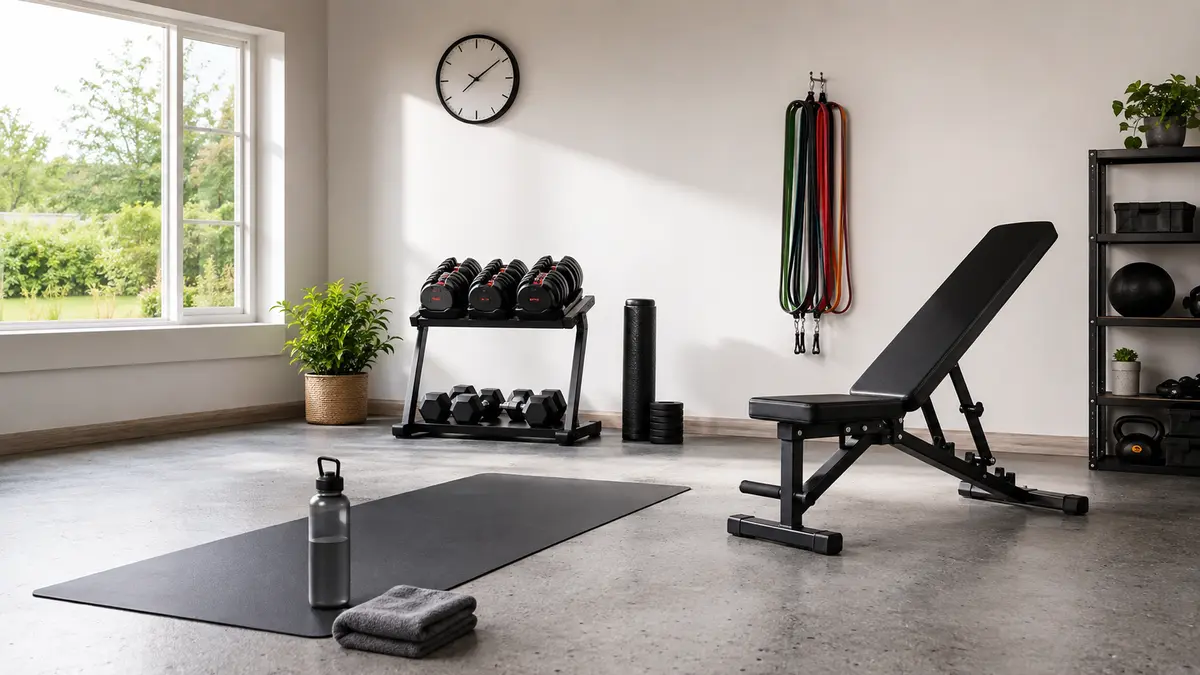
Strength training at home for beginners can be simple, safe, and effective. You do not need a crowded gym or a large equipment collection. A small clear space, a stable chair, a few basic movement patterns, and a plan for gradual progression are enough to build a useful routine.
This guide explains preparation, technique, exercise selection, a 12-week schedule, progression, recovery, and common mistakes. It is general fitness education, not medical treatment. Anyone with a health condition, injury, unexplained symptoms, pregnancy, recent surgery, significant inactivity, or concerns about exercise should seek individualized advice before starting.
Why strength training belongs in an adult activity plan
The CDC adult physical activity guidance recommends muscle-strengthening activity on two or more days each week that works all major muscle groups: legs, hips, back, abdomen, chest, shoulders, and arms. It also recommends aerobic activity. Strength work and cardio support different parts of a balanced plan.
Resistance training can improve the ability to perform daily tasks, maintain muscle, support bone health, and increase confidence with lifting, carrying, climbing, and getting up from a chair. Progress comes from repeated practice and gradual challenge, not from feeling exhausted after every session.
Check readiness and set a realistic goal
Begin by defining a practical outcome. Examples include completing two full-body sessions each week, carrying groceries more comfortably, performing ten controlled chair squats, or building a routine that supports another sport. A behavior goal is often more useful than an appearance goal because it tells you what to do this week.
Know when to ask a professional
Consult an appropriate clinician or qualified exercise professional when you have cardiovascular, metabolic, neurological, joint, balance, pelvic-floor, or other concerns; take medicine that affects exercise response; or do not know whether a movement is appropriate. Stop exercise and seek urgent help for chest pain, fainting, severe shortness of breath, sudden weakness, or another emergency symptom.
Ordinary muscle effort is not the same as sharp pain, joint pain, numbness, dizziness, or a feeling that something is wrong. Do not push through concerning symptoms to complete a written plan.
Prepare a safe home training space
Clear an area large enough to extend the arms and step in every direction without hitting furniture, fans, pets, children, or fragile objects. Use a non-slip surface and good lighting. Keep the room comfortably ventilated and place water nearby.
If an exercise uses a chair, choose one that is sturdy, level, and unlikely to slide. Do not use a rolling office chair. Inspect bands for cracks and dumbbells for loose collars. Wear footwear that suits the surface and your needs, or train barefoot only when appropriate and safe.
Basic equipment options
- Body weight: Useful for squats, wall push-ups, bridges, calf raises, and controlled holds.
- Resistance bands: Portable and versatile, but they must be anchored safely and inspected before use.
- Dumbbells: Easy to progress in small steps and hold close to the body.
- Backpack: Can provide adjustable load when the bag and contents are secure and comfortable.
- Stable step: Useful for low step-ups if it does not move or tip.
Household objects are not automatically safe weights. Avoid containers that leak, shift unexpectedly, or are difficult to grip. A low-cost pair of adjustable dumbbells or bands may be a better investment than improvised equipment that changes shape during a lift.
Learn the six basic movement patterns
A full-body beginner plan can be built from a squat, hinge, push, pull, carry, and trunk-stability exercise. These are categories, not rigid techniques. Choose a version that allows control and a comfortable range.
1. Squat
The squat trains sitting and standing. Begin with a chair squat. Stand in front of a stable chair with feet in a comfortable stance. Reach the hips back, bend the knees, touch the chair lightly, and stand by pressing the feet into the floor. Keep the knees tracking in the same general direction as the toes.
Make it easier with a higher seat or light hand support. Progress by reducing support, slowing the lowering phase, holding a weight at the chest, or using a lower target when comfortable.
2. Hip hinge
The hinge trains the hips and back of the legs. Stand near a wall with a soft knee bend and push the hips backward until they touch the wall, keeping the spine long and the load close to the body. The movement comes mainly from the hips rather than turning into a deep squat.
Progress to a light Romanian deadlift with dumbbells or a backpack. Stop the descent before the back rounds or balance changes. The goal is controlled tension, not reaching the floor.
3. Push
Begin with a wall push-up. Place the hands slightly wider than shoulder width, step back, keep the body in a straight comfortable line, bend the elbows, and bring the chest toward the wall. Press away without shrugging.
Progress to a sturdy counter, then a lower stable surface, and eventually the floor if appropriate. Changing the angle allows gradual loading without forcing a difficult version.
4. Pull
A one-arm supported row is an accessible pull. Support one hand on a stable surface, hold a light weight in the other, and pull the elbow toward the hip while keeping the shoulder away from the ear. Lower slowly.
Bands can also provide rows when anchored to a purpose-built secure point. Never attach a band to a light door handle, unstable furniture, or a surface that may release toward the face.
5. Carry
Hold equal weights at the sides, stand tall, and walk slowly through a clear path. Keep breathing and avoid leaning. A suitcase carry uses one weight and challenges the body to resist side bending, but begin with two balanced loads if that feels more stable.
6. Trunk stability
A dead bug, bird dog, or elevated plank can train the trunk without repeated bending. For a bird dog, begin on hands and knees, brace gently, and extend one leg only as far as the trunk remains steady. Add the opposite arm after mastering balance.
Trunk training is not a contest to hold the breath. Use a version that allows normal breathing and controlled alignment.
Warm up for the session
A warm-up prepares the movements you will perform. Spend five to ten minutes increasing temperature and rehearsing the exercises with an easier range or load.
- Walk in place or around the room for two minutes.
- Perform gentle shoulder circles and ankle movements.
- Complete five easy chair squats.
- Practice five unloaded hinges.
- Do five wall push-ups and five light rows per side.
- Repeat any movement that feels stiff with a comfortable smaller range.
Long, intense stretching is not required before a basic strength session. Use dynamic, task-specific preparation and save longer flexibility work for a separate or post-training period if it suits your needs.
Choose sets, repetitions, and effort
Beginners can start with one or two sets of eight to twelve controlled repetitions for each main exercise. A set is a group of repetitions followed by rest. The last few repetitions should feel challenging while technique remains stable.
Use an effort scale from one to ten. Early sessions may finish around six or seven: you could perform roughly three or four more good repetitions if necessary. Avoid training to complete failure while learning. Confidence and consistency matter more than maximal effort.
Rest between sets
Rest long enough to repeat the movement with control, often one to three minutes. Larger movements and heavier loads may require more rest. Short rest is not automatically better; it may turn strength practice into rushed conditioning and reduce technique quality.
Breathing
Keep breathing instead of holding the breath for long periods. A simple pattern is to exhale during the harder part and inhale during the easier part. People with blood-pressure, pelvic-floor, cardiovascular, or other concerns should get individualized guidance about breathing and loading.
The 12-week beginner home strength plan
Train on two non-consecutive days each week, such as Monday and Thursday. A third session may be added later if recovery, schedule, and goals support it. Begin each session with the warm-up.
| Phase | Weeks | Sets | Focus |
|---|---|---|---|
| Learn | 1–2 | 1 per exercise | Comfortable range, slow repetitions, leave several in reserve |
| Build | 3–5 | 2 per exercise | Repeatable technique and regular attendance |
| Progress | 6–9 | 2–3 per exercise | Add repetitions, range, or small load gradually |
| Consolidate | 10–12 | 2–3 per exercise | Stable routine and clear next-step goals |
Workout A
- Chair squat — 8 to 12 repetitions
- Wall or counter push-up — 8 to 12 repetitions
- Supported one-arm row — 8 to 12 per side
- Glute bridge — 8 to 12 repetitions
- Farmer carry — 20 to 40 seconds
- Bird dog — 5 to 8 controlled repetitions per side
Workout B
- Low step-up or supported split squat — 6 to 10 per side
- Light overhead press or inclined push-up — 8 to 12 repetitions
- Band row or dumbbell row — 8 to 12 repetitions
- Romanian deadlift or wall hinge — 8 to 12 repetitions
- Suitcase carry — 15 to 30 seconds per side
- Elevated plank or dead bug — 15 to 30 seconds or 5 to 8 per side
Overhead work and step-ups are not appropriate for everyone. Substitute a comfortable variation. For example, use another push instead of overhead pressing or repeat chair squats instead of step-ups.
How to progress without rushing
Use “double progression.” Keep the load the same while increasing repetitions within the planned range. When all sets reach the top of the range with stable technique and several repetitions still available, add the smallest practical amount of resistance and return to the lower end.
Progress only one main variable at a time:
- Add one or two repetitions.
- Add a set, within the plan.
- Increase the comfortable range of motion.
- Slow the lowering phase.
- Use a slightly harder angle or variation.
- Add a small amount of load.
Do not add load, repetitions, sets, and a harder variation in the same week. Small changes compound and are easier to evaluate.
Track training simply
Record the date, exercise, variation, load, sets, repetitions, effort, and any useful note. A notebook is enough. Example: “Chair squat, 2 × 10, 6/10 effort, felt stable.” The record tells you when to repeat, progress, or reduce the session.
Every four weeks, review consistency, movement confidence, and a practical test. You might measure comfortable chair squats in a fixed set, carry time with the same load, or the height used for push-ups. Avoid frequent maximal tests.
Recovery, food, and sleep
Strength improves during the combination of training and recovery. Leave at least a day between beginner full-body sessions, maintain ordinary daily movement, and use gentle activity if it helps soreness. Severe or worsening pain is not normal recovery.
Eat a varied, balanced diet that supplies enough energy and protein for your needs. Protein can be distributed across meals using suitable halal foods such as eggs, dairy, fish, poultry, meat, beans, lentils, soy, nuts, and seeds according to dietary needs and preferences. Supplements are optional, not a foundation, and may interact with health conditions or medicine.
Sleep supports learning and recovery. Use the practical sleep hygiene tips for adults to build a consistent routine. Training late at night is fine for some people but stimulating for others; test the timing.
Combine strength and cardio
Strength work does not replace aerobic activity. The CDC recommends at least 150 minutes of moderate-intensity aerobic activity per week, or 75 minutes of vigorous activity, or an equivalent combination, in addition to muscle-strengthening days. Beginners can build gradually.
A simple week might include two strength sessions, three brisk walks, and easy movement on other days. Do the activity that matters most while fresh. If strength is the priority, lift before a demanding cardio session or separate them by several hours or days.
Common beginner mistakes
Doing too much in week one
A punishing first session creates soreness without building a habit. Finish early sessions feeling capable of more. Add work after the routine proves repeatable.
Changing exercises constantly
Variety is enjoyable, but progress is hard to measure when every session is different. Keep the main patterns for four to eight weeks and vary only when a movement is inappropriate, painful, or no longer useful.
Copying advanced workouts
Advanced routines assume skill, recovery capacity, and equipment that a beginner may not have. A basic full-body plan performed consistently is more valuable than a complicated split.
Using momentum
Fast swinging may move a heavier object while reducing control. Slow down, stabilize the body, and use a load that stays in the intended path.
Ignoring balance between patterns
Doing only push-ups and curls leaves large muscle groups untrained. Include legs, hips, back, trunk, pushing, and pulling.
Believing soreness proves success
Soreness can occur after unfamiliar exercise but is not required for progress. Consistent performance, gradual loading, and recovery are better indicators.
How to modify a difficult movement
| Movement | Easier option | Progression |
|---|---|---|
| Squat | Higher chair with hand support | Lower chair or light goblet load |
| Push-up | Wall | Counter, bench, then floor |
| Hinge | Hip-to-wall drill | Light Romanian deadlift |
| Row | Very light supported row | More load or band tension |
| Plank | Wall or counter | Lower stable surface |
| Step-up | Chair squat | Low stable step with support |
Technique cues that make practice easier
Technique is not about forcing every body into an identical shape. It is a repeatable way to move through a comfortable path while controlling the load. Film a short set from the side only if privacy allows, or ask a qualified professional to observe. Compare the movement with the intended cues, not with an advanced athlete using a different exercise.
Use a stable starting position
Before each repetition, feel the feet or support points, organize the grip, and create gentle tension through the trunk. A stable start reduces rushed corrections halfway through the lift. For standing exercises, distribute pressure across the heel, base of the big toe, and base of the little toe without gripping the floor painfully.
Control the lowering phase
Take approximately two or three seconds to lower the weight or body in early practice. A controlled descent makes the path easier to feel and discourages bouncing. Pause briefly in a comfortable position, then return smoothly. Speed can increase later for specific goals under suitable guidance.
Keep the load close
During carries, hinges, rows, and lifting from a surface, keep the object close to the body. Reaching a weight far forward increases the demand and can make a light object feel surprisingly heavy. Set up close to the item before lifting it.
End the set when form changes
The planned number is a target, not a command. Stop when the range shortens unintentionally, balance changes, breathing becomes uncontrolled, the weight drifts, or you cannot repeat the previous technique. Record the completed number and adjust the next set.
Example week with strength, walking, and recovery
| Day | Activity | Purpose |
|---|---|---|
| Monday | Workout A, 30–45 minutes | Full-body strength |
| Tuesday | Comfortable walk and mobility | Aerobic activity and recovery |
| Wednesday | Rest or easy daily movement | Recovery |
| Thursday | Workout B, 30–45 minutes | Full-body strength |
| Friday | Brisk walk | Aerobic activity |
| Saturday | Longer easy activity or recreation | Enjoyable movement |
| Sunday | Rest and plan next week | Recovery and consistency |
This is an example, not a requirement. Move sessions around work, family, worship, weather, and health. Keep at least one day between demanding full-body sessions. If the week becomes busy, perform one set of the main movements instead of abandoning the routine. A 20-minute session preserves the habit.
Training for older beginners
Older adults benefit from strength work and should also include balance activity. The CDC recommends muscle strengthening on two or more days and balance activities in addition to aerobic movement. Start with stable support and an environment that reduces fall risk.
Chair squats, supported heel raises, wall push-ups, rows, carries, and controlled step practice may be useful choices when individually appropriate. Keep a stable counter nearby for balance exercises but do not depend on furniture that can move. Progress balance by narrowing support or reducing hand contact only when the current level is safe.
People with osteoporosis, joint replacement, arthritis, neuropathy, dizziness, vision limitations, or a history of falls need exercise selection matched to their condition. A physical therapist or suitably qualified professional can help choose range, load, and support. The goal is confident function, not copying a generic online demonstration.
What to do after week twelve
Review the training log. If attendance is consistent, technique is stable, and recovery is good, continue the same framework with gradually heavier resistance. You might add a third set to selected exercises, move from two to three sessions, or choose a specific goal such as stronger carries, floor transfers, or push-ups.
Change only part of the program. Keep several familiar movements while learning one new exercise. If progress has stopped, check sleep, food, effort, range, and consistency before adding more complexity. A lighter week with roughly half the usual sets can be useful after a demanding period, illness, travel, or accumulated fatigue.
Beginner strength checklist
- Choose two non-consecutive training days.
- Clear the space and inspect equipment.
- Warm up with easy versions of the planned movements.
- Train all major muscle groups across the week.
- Start with one or two sets of controlled repetitions.
- Leave several good repetitions in reserve.
- Rest long enough to maintain technique.
- Progress one variable at a time.
- Record the session.
- Stop for concerning symptoms and seek appropriate help.
- Support training with food, sleep, and aerobic activity.
- Review the program after four weeks.
Frequently asked questions
How many days should a beginner strength train?
Two non-consecutive full-body sessions per week are a practical starting point and align with the CDC recommendation for muscle-strengthening activity on at least two days. Add training only when recovery and consistency are good.
Can body-weight exercise build strength?
Yes, especially for beginners. Progress by changing leverage, range, repetitions, sets, tempo, or stability. Eventually some movements may need external resistance for continued progress.
How heavy should beginner weights be?
Choose a load that allows the planned repetitions with controlled technique and roughly three or four good repetitions still available in early sessions. Increase gradually after reaching the top of the range across all sets.
Should I train when sore?
Mild soreness may allow light activity or a modified session, but severe, sharp, worsening, or joint pain is a reason to stop and assess. Repeatability matters more than forcing one workout.
Do I need protein powder?
No. Many people can meet protein needs with ordinary food. A powder may be convenient but is not required. Choose products carefully and seek advice when health conditions, allergies, or medication are relevant.
When will I see results?
Movement confidence and coordination may improve within weeks, while visible changes and larger strength gains take longer. Training history, sleep, food, genetics, consistency, and program design all matter. Judge the plan after at least eight to twelve steady weeks.
Final takeaway
Strength training at home for beginners works when the plan is safe, simple, and progressive. Practice the squat, hinge, push, pull, carry, and trunk patterns twice a week. Start below your maximum, record each session, and change only one variable at a time. The goal is not to win the first workout; it is to build a routine you can still perform with confidence in week twelve.