
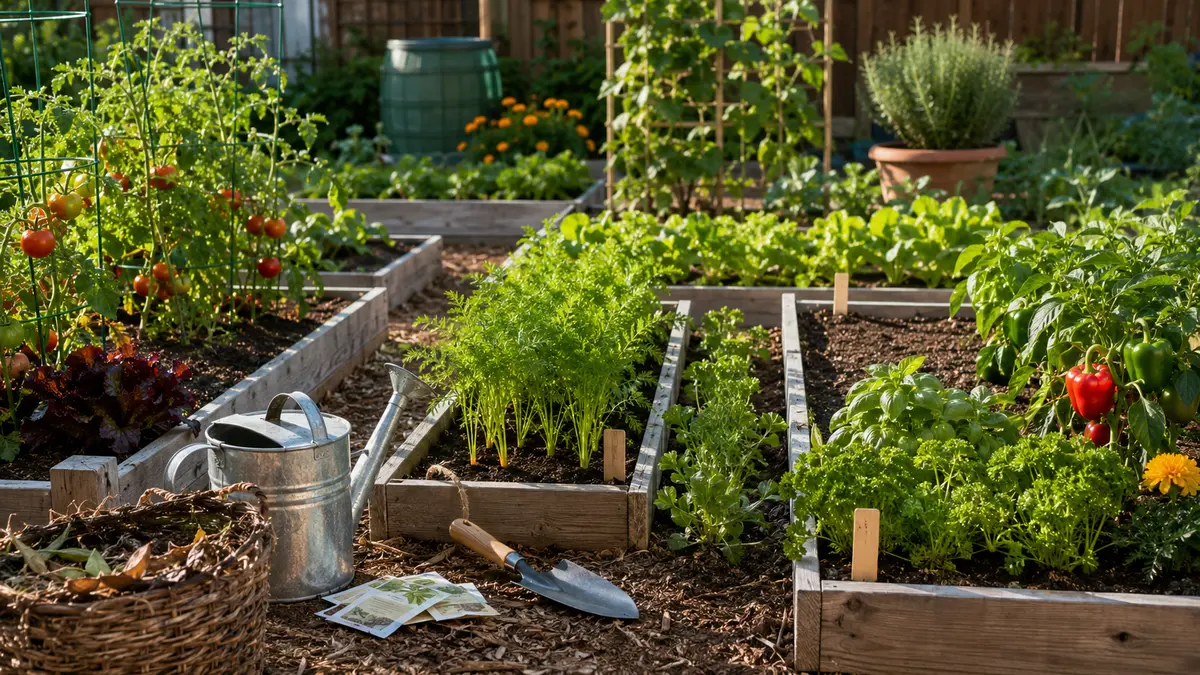
Vegetable gardening for beginners works best when the first garden is small, sunny, close to water, and filled with crops you actually eat. A successful first season is not the biggest harvest. It is learning how the site behaves, keeping a manageable number of plants healthy, and building a routine you can repeat.
This complete guide covers site selection, containers and raised beds, soil, crop choice, planting, watering, feeding, weeds, pests, succession planting, harvest, and a simple first-season plan. Climate, soil, crop timing, and pest pressure are local, so use your regional agricultural extension or equivalent public horticulture service for planting dates and diagnoses.
Start with a small first garden
The USDA National Agricultural Library summarizes starting a vegetable garden in six steps: planning, selecting a site, preparing soil, planting, maintaining the garden, and harvesting. That sequence prevents a common beginner mistake—buying many seeds before deciding where and how they will grow.
A bed around 1.2 by 2.4 meters (4 by 8 feet), four to six medium containers, or several large grow bags can teach nearly every basic skill without becoming overwhelming. Leave space to reach every plant without stepping on the growing soil.
Write a simple goal
Choose one outcome such as “harvest salad greens and herbs for eight weeks” or “grow tomatoes, peppers, and beans for family meals.” The goal determines crops, space, support, and timing. Avoid choosing vegetables only because they look impressive online.
Choose the best available site
Measure sunlight
Most fruiting vegetables such as tomatoes, peppers, cucumbers, and squash need strong direct sun. The University of Minnesota’s raised-bed guidance recommends at least six to eight hours of sunlight for crops such as tomatoes, peppers, and eggplants. Leafy greens and some root crops can tolerate less.
Observe the proposed area several times on a clear day. Buildings and trees change shade as the season progresses. A sunny winter location may be shaded when deciduous trees leaf out.
Stay close to water
A garden that requires carrying heavy watering cans across a property will be neglected during hot weather. Choose a site near a safe water source and plan a hose, watering can, or drip system that reaches without crossing a public path or creating a trip hazard.
Look for drainage
Avoid low places that remain waterlogged after rain. Roots need air as well as water. In heavy or poorly drained soil, raised beds may improve the root zone, but they do not fix a major site drainage or contaminated-water problem.
Check access and safety
Keep the garden away from treated utility poles, unknown fill, busy roads, contaminated runoff, and areas with a history of industrial use unless testing confirms suitability. Contact the utility-location service before digging. Use barriers where children or pets could access sharp tools or toxic products.
Choose in-ground, raised-bed, or container gardening
In-ground beds
In-ground gardening uses existing soil and may require less frequent watering than containers. It works well when the soil is safe, reasonably drained, and workable. Avoid tilling wet soil because compaction can damage structure.
Raised beds
Raised beds provide control over the growing mix and can improve access and drainage. They also cost more, dry faster, and require enough soil to fill. Use durable materials suitable for food-growing spaces and design the width so the center is reachable from the sides.
Containers and grow bags
Containers are useful for balconies, patios, rented homes, and small sunny spaces. Every container needs drainage holes and a growing mix formulated for containers. Garden soil alone can compact in a pot. Larger containers buffer moisture and temperature better than tiny pots.
Match crop to container. Herbs and lettuce can use moderate containers, while tomatoes, cucumbers, eggplants, and squash need substantial root volume and support. Check the mature size of the specific variety.
Understand and prepare soil
Soil supplies water, air, nutrients, and physical support. Texture describes the balance of sand, silt, and clay. Organic matter influences structure and biological activity. pH affects nutrient availability. Guessing from color alone is not reliable.
Test before adding fertilizer
Use a reputable laboratory or local extension soil test. Request pH, organic matter, and nutrient recommendations for vegetables. In an urban or previously developed area, ask whether heavy-metal testing is appropriate. Follow sampling instructions so the result represents the bed.
Do not add lime, sulfur, phosphorus, or other concentrated amendments without evidence. Excess nutrients can harm plants and pollute water. “More” is not a substitute for balanced soil.
Add mature compost thoughtfully
Well-finished compost can improve soil structure and supply organic matter. Spread the amount recommended for the site and mix it into a new bed where appropriate, or use it as a surface amendment. Immature compost, fresh manure, and unknown material can damage plants, introduce weeds, or create food-safety concerns.
Do not work wet soil
Squeeze a handful. If it forms a sticky ball and smears, wait for it to dry. Working saturated soil destroys pore space and creates hard clods. Use defined paths and avoid stepping in beds during the season.
Choose beginner-friendly vegetables
Select crops that suit the climate, season, space, and kitchen. Read the seed packet or plant label for days to maturity, spacing, sun, support, and temperature.
Fast and forgiving crops
- Leaf lettuce: Quick harvest and suitable for repeated sowing in cool conditions.
- Radish: Fast, but quality declines in hot weather or crowded soil.
- Bush beans: Direct-sown and productive in warm soil.
- Swiss chard: Long harvest and tolerates some heat.
- Herbs: Parsley, coriander, mint in a container, and basil where climate suits.
- Cherry tomato: Productive with strong sun, a large container or bed, and support.
- Peppers: Useful in warm seasons but slower and often started as transplants.
Mint spreads aggressively in the ground, so a separate container is often safer. Zucchini can be productive but occupies much more space than a beginner expects. One plant may be enough for a small household.
Choose varieties for the garden
Compact, patio, bush, or determinate varieties may fit containers. Disease-resistant varieties can reduce risk where specific diseases are common. Local extension trials and reputable seed suppliers provide more relevant guidance than a generic global list.
Know the planting seasons
Cool-season crops such as peas, lettuce, radish, spinach, and many brassicas tolerate cooler conditions. Warm-season crops such as tomatoes, peppers, beans, cucumber, okra, eggplant, and squash need warmer soil and air. Exact timing depends on location.
Find the local average last spring frost, first autumn frost, heat periods, monsoon or rainy season, and day length. Use a regional planting calendar. Do not copy dates from a gardener in another hemisphere or climate zone.
Seeds or transplants?
Beans, peas, radish, carrots, cucumbers, squash, and many greens are commonly direct-sown. Tomatoes, peppers, eggplant, and some brassicas are often transplanted to gain time. Root crops usually dislike transplant disturbance.
Transplants should be compact, healthy, and appropriate to the season. Avoid root-bound, flowering, pest-infested, or stressed plants. Harden indoor-grown seedlings gradually before planting outdoors.
Plant at the correct depth and spacing
Read the seed packet. A common rule is to sow seeds about two to three times as deep as their diameter, but tiny seeds may need only a light covering and some crops have specific requirements. Keep the seedbed evenly moist without washing seeds away.
Spacing affects light, airflow, root competition, and disease. Crowding many seedlings into a small area does not produce more usable food. Thin seedlings according to the crop recommendation, keeping the strongest in a suitable pattern.
Label the crop, variety, and sowing date. A simple garden map prevents accidental digging and helps identify seedlings among weeds.
Water deeply and consistently
Water needs vary with crop, growth stage, soil, wind, temperature, container size, and rainfall. Seedlings need frequent gentle moisture near the surface. Established plants benefit from deeper watering that reaches the active roots.
Check the soil, not only the calendar
Insert a finger or small trowel several centimeters into the soil. If the root zone is dry, water slowly. If it is already moist, wait. Containers may need daily checks in hot or windy weather.
Water the soil
Apply water near the base rather than routinely wetting foliage. A watering wand, soaker hose, or drip system can reduce splash and evaporation. If overhead watering is the only practical method, water early enough for foliage to dry and follow local disease guidance.
Avoid runoff
Apply water slowly so it soaks in. On crusted or very dry soil, make two passes with a pause between. Repair leaks and adjust emitters so paths are not watered. Collect rainwater only where legal and with a covered, safely designed system that does not breed mosquitoes or create contamination.
Use mulch for moisture and weeds
After the soil warms and plants are established, apply a layer of clean organic mulch such as straw, shredded leaves, or another locally appropriate material. Keep it slightly away from stems. Mulch reduces evaporation, suppresses weeds, moderates soil temperature, and limits soil splash.
Do not use material treated with persistent herbicides or contaminated with weed seed. Very thick mulch against a building may shelter pests. In cool wet climates, heavy early mulch can delay soil warming.
Feed plants based on need
Follow the soil test and crop guidance. Nitrogen supports leafy growth, but excess can produce large leaves with fewer fruits, weak tissue, pollution, or salt buildup. Container nutrients leach with watering and may need a controlled feeding plan.
Choose a clearly labeled fertilizer appropriate to vegetables and follow the rate. Keep granules off leaves and stems, water as directed, and store products safely. Do not combine several fertilizers without calculating the total nutrients.
Control weeds early
Weeds compete most strongly when vegetables are young. Identify a plant before removing it. Pull after rain or watering when roots release easily, hoe shallowly on a dry day, and mulch clean soil. Avoid deep cultivation near vegetable roots.
Do not allow aggressive weeds to set seed. Place diseased, seeding, or invasive material in the disposal stream recommended locally rather than an ordinary home compost pile.
Use integrated pest management
Not every insect is a pest. Many are pollinators, predators, decomposers, or harmless visitors. Integrated pest management begins with correct identification, prevention, monitoring, and the least disruptive effective control.
Inspect twice a week
Look at upper and lower leaf surfaces, growing tips, stems, soil line, and fruit. Note holes, spots, wilting, sticky residue, eggs, insects, and weather. Photograph the whole plant and a close detail for identification.
Prevent problems
- Plant at the right season and spacing.
- Use healthy transplants and resistant varieties.
- Rotate plant families where space allows.
- Remove diseased residue appropriately.
- Water consistently and avoid excess nitrogen.
- Use physical barriers before pests arrive.
- Keep tools and containers reasonably clean.
Choose a targeted response
Hand-pick large pests, prune a limited infected part, use row cover, or apply a crop- and pest-specific product only after correct identification. “Organic” pesticides can still harm people, pollinators, pets, and water. Follow the label, harvest interval, protective equipment, and local law exactly.
Support pollinators without harming crops
Grow a variety of locally suitable flowers with overlapping bloom periods, provide clean shallow water where mosquitoes cannot breed, and reduce broad-spectrum pesticide use. Many vegetables such as beans, lettuce, radish, and leafy greens do not require animal pollination for the harvested part, while cucumbers and squash do.
Flower drop can result from temperature, water stress, or pollination problems. Diagnose the pattern before adding a beehive or spraying a product.
Add simple plant supports
Install trellises, cages, and stakes before plants become large. Secure them against wind without piercing utilities or irrigation. Tie stems loosely with soft material and check as they expand.
Vertical growth can improve airflow and make harvest easier, but it may cast shade. Place tall crops where they will not block shorter sun-loving plants.
Practice succession planting
Succession planting spreads harvest. Sow a short row of lettuce, radish, or beans every two or three weeks within the appropriate season instead of planting the entire packet at once. Replace a finished cool-season crop with a warm-season crop, then plant another cool crop as temperatures fall.
Check days to maturity and remaining season length. Add extra time as days shorten or weather cools. Do not plant a second crop if soil disease or pest pressure makes rotation wiser.
Harvest for quality and continued production
Harvest during the cooler part of the day, use clean tools, and handle produce gently. Pick beans, cucumbers, and summer squash regularly to encourage continued production. Harvest leafy greens at the stage recommended for the variety.
Wash hands, use clean containers, keep animals out of the growing area, and follow food-safety guidance for water, manure, compost, harvest, washing, and storage. Do not wash produce with soap or household chemicals. Use safe potable water and official food-safety advice.
A simple first-garden plan
| Space | Crop | Purpose |
|---|---|---|
| Back/north side | Supported cherry tomato or cucumber | Vertical warm-season crop |
| One quarter | Bush beans | Easy direct-sown harvest |
| One quarter | Leaf lettuce or chard | Repeated leaf harvest |
| Short row | Radish, repeated sowing | Fast crop and timing practice |
| Edge pots | Parsley, coriander, basil | Kitchen herbs with different seasons |
| Separate pot | Mint | Contain spreading roots |
Adjust the orientation to the hemisphere and sun path. Substitute vegetables your household eats. One healthy tomato is a better learning crop than six crowded plants.
A 12-week beginner schedule
- Week 1: Observe sun, water, drainage, and access.
- Week 2: Test soil or buy a suitable container mix.
- Week 3: Choose crops, varieties, planting dates, and layout.
- Week 4: Prepare beds or containers and install irrigation.
- Week 5: Sow or transplant crops appropriate to local conditions.
- Week 6: Thin seedlings, label, and record emergence.
- Week 7: Mulch established plants and inspect for pests.
- Week 8: Install or adjust supports.
- Week 9: Sow the next short succession.
- Week 10: Harvest early crops and update the map.
- Week 11: Review water, nutrition, weeds, and disease.
- Week 12: Record yields and plan the next crop.
Common beginner mistakes
Starting too large
A huge garden creates weeds and watering pressure before skills develop. Start small and expand after a successful season.
Ignoring mature size
A seedling is not the final plant. Check spacing, support, and root volume for the mature variety.
Watering the surface only
A brief sprinkle encourages shallow roots and may not reach the crop. Check the root zone and water slowly.
Adding fertilizer to every problem
Yellow leaves can result from water, roots, temperature, disease, pests, pH, or nutrients. Diagnose before feeding.
Using pesticides before identification
A product may not control the actual problem and can harm helpful organisms. Identify the crop, pest, life stage, and damage threshold first.
Forgetting to harvest
Overmature beans, cucumbers, and squash lose quality and can slow further production. Walk the garden every day or two in peak season.
End-of-season care
Remove supports, clean tools, dispose of diseased material appropriately, and compost healthy residue if the pile can manage it. Cover bare soil with mulch or a locally suitable cover crop. Empty or protect containers according to climate and material.
Update the map with crop locations, varieties, sowing dates, first and last harvest, pests, disease, yield, and taste. Save seed only from suitable open-pollinated plants when you understand isolation and disease risks. Store remaining commercial seed cool, dry, and labeled.
Growing vegetables on a balcony or rooftop
Before placing containers on a balcony or roof, confirm building rules, structural load limits, drainage, wind, and safe access. Wet soil is heavy, and a collection of large pots can create a substantial load. Never block an exit, drain, guardrail, fire route, or maintenance access.
Wind dries plants and can overturn containers. Use broad stable pots, secure trellises to an approved structure, and choose compact varieties. Do not attach anything to a railing in a way that could fall. A self-watering container can reduce daily stress, but overflow and stagnant reservoirs still require management.
Balconies create unusual light. Upper floors may receive intense sun and reflected heat, while a deep covered balcony may receive only a few hours. Measure direct sun at plant height. Lettuce, chard, parsley, coriander, radish, scallions, and some herbs may suit lower light better than tomatoes or peppers.
Compost safely at home
Compost turns suitable plant material into a soil amendment, but a neglected pile can smell, attract pests, or remain unfinished. Balance moist nitrogen-rich material such as vegetable scraps and fresh garden residue with dry carbon-rich material such as shredded leaves or plain cardboard. Keep the pile as damp as a wrung sponge and add air by turning or using a ventilated design.
Do not add meat, fish, dairy, oil, pet waste, diseased plants, weeds with mature seed, invasive plants, or chemically contaminated material to a basic home pile unless local expert guidance and the system specifically allow it. Cover food scraps with dry material. If rodents or odor appear, stop adding food and correct the balance and enclosure.
Finished compost should be dark, crumbly, and earthy, with no recognizable food. If the material is still warm, sour, or actively decomposing, allow more time. Use mature compost in the amount recommended for the bed rather than burying large volumes beside roots.
Rotate crops in a small garden
Rotation means avoiding the same plant family in the same bed season after season. It can reduce the buildup of some soil-borne pests and diseases, but it does not solve every problem. Group crops roughly as nightshades, cucurbits, legumes, brassicas, alliums, and root or leaf families, then use the garden map to move them.
In a very small bed, complete rotation may be impossible. Remove infected residue, use containers with fresh appropriate mix when necessary, choose resistant varieties, and avoid planting a crop with a known recurring soil disease in the same spot. Local diagnostic help is more useful than a rigid four-year diagram when the actual problem is unknown.
Frequently asked questions
What vegetables are easiest for beginners?
Leaf lettuce, radish, bush beans, Swiss chard, herbs, and cherry tomatoes are common beginner choices when planted in the correct season. Local climate and the vegetables you eat matter more than a universal list.
How much sun does a vegetable garden need?
Many fruiting crops need six to eight hours of direct sun. Leafy greens can tolerate less. Observe the site through the day and check the variety’s requirements.
Can I use garden soil in containers?
Garden soil alone often compacts and drains poorly in pots. Use a high-quality growing mix formulated for containers and ensure drainage holes remain open.
How often should I water vegetables?
There is no fixed schedule. Check the root zone and adjust for crop, soil, container, rainfall, wind, heat, and growth stage. Water slowly and deeply enough to reach active roots.
Do I need raised beds?
No. In-ground beds work well in safe, well-drained soil. Raised beds can improve access and growing-mix control but cost more and dry faster. Choose the system that solves a real site problem.
How do I keep pests away without harmful chemicals?
Use correct timing, healthy soil, crop spacing, resistant varieties, barriers, inspection, hand removal, sanitation, and targeted controls after identification. Any pesticide, including an organic one, requires label compliance.
Final takeaway
Vegetable gardening for beginners becomes manageable when you start small, measure sunlight, prepare safe soil, choose seasonal crops, water the root zone, inspect twice a week, and keep records. Grow food your household will eat, use local extension guidance, and treat the first season as an experiment. A modest garden learned well is the foundation for many larger harvests.


